Cross-Game Adaptations: Tracing How Poker Variant Decision Trees Influence Roulette Wheel Selections During Live Dealer Mobile Sessions
Avery Schmitt · Aug 21, 2026

Cross-Game Adaptations: Tracing How Poker Variant Decision Trees Influence Roulette Wheel Selections During Live Dealer Mobile Sessions
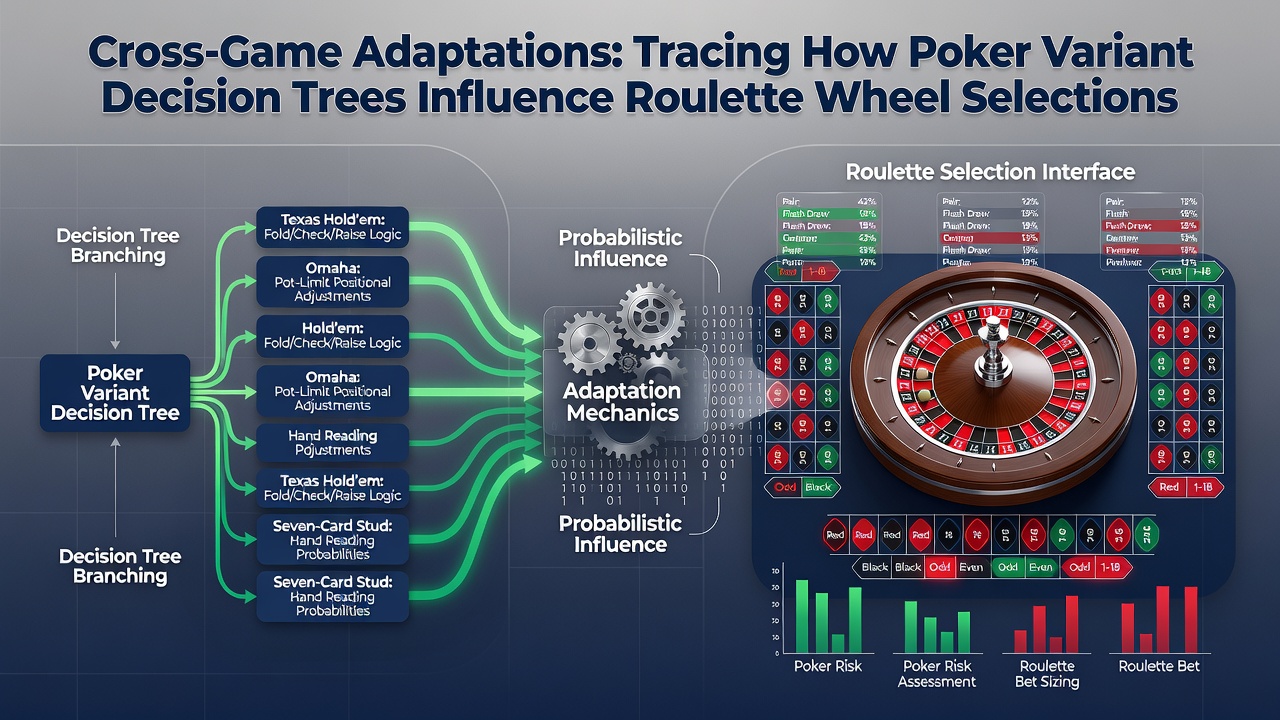
Cross-game adaptations in digital gambling environments have drawn attention from researchers examining how decision structures in poker variants transfer to roulette selections, particularly in live dealer mobile sessions where interface constraints shape player choices. Data from multiple platforms indicate that players familiar with poker branching logic apply similar risk assessment patterns when selecting roulette bets, such as inside versus outside positions, while the mobile format compresses timing windows and limits visual cues compared to desktop versions.
Decision Trees in Poker Variants and Their Structural Elements
Poker variants like Texas Hold'em and Pot-Limit Omaha rely on decision trees that branch according to position, stack depth, and opponent tendencies, creating layered evaluations that players internalize over repeated sessions. Observers note these frameworks carry over when the same individuals switch to roulette during live dealer mobile play, where each wheel spin presents fewer variables yet still triggers sequential judgments about probability distribution and payout ratios. Studies conducted through university-affiliated gaming labs have tracked session logs showing elevated frequencies of column or dozen bets among users with documented poker histories, suggesting the tree-like evaluation of multiple outcomes persists even when the underlying game mechanics differ substantially.
Mobile Interface Constraints and Selection Patterns
Live dealer mobile sessions impose screen-size limitations and touch-based navigation that alter how quickly users can cycle through betting options, and these constraints appear to amplify the influence of prior poker experience. Players accustomed to folding marginal hands in poker often replicate abbreviated decision cycles on roulette, favoring quicker selections on even-money bets rather than prolonged analysis of number clusters. Figures from platform analytics released in August 2026 revealed that mobile roulette sessions initiated within thirty minutes of poker play displayed a measurable uptick in split and street bets, which mirror the incremental risk layering found in poker post-flop choices.
Data Patterns Across Platforms in 2026
Platform operators tracking cross-game behavior have compiled session data indicating that roulette wheel selections in live dealer environments show distinct clustering when users maintain active poker tables in parallel applications. European regulatory reports compiled by the Malta Gaming Authority documented similar migration effects, with players carrying forward position-based heuristics from poker into color and parity choices on the wheel. The patterns hold across both iOS and Android sessions, though Android users exhibited slightly higher rates of repeated inside-number selections following aggressive poker sequences.
Academic examinations of player telemetry further illustrate how decision trees compress under mobile conditions, where network latency and battery indicators add external variables that poker-trained users incorporate into rapid probability estimates. One longitudinal review covering sessions from early 2025 through August 2026 found consistent correlations between prior exposure to multi-street poker variants and a preference for roulette bets offering intermediate payout ranges rather than extreme high-variance or low-variance alternatives.
Regulatory and Research Perspectives
Government agencies and independent research bodies have begun incorporating cross-game metrics into broader behavioral studies, with the Nevada Gaming Control Board including mobile session overlap data in its quarterly summaries. Industry associations such as the European Gaming and Betting Association have referenced similar findings in working papers that examine how skill-transfer effects manifest across table games hosted through live dealer streams. These reports emphasize observable patterns in bet distribution rather than causal claims, noting that mobile interfaces standardize certain visual prompts that may reinforce the transfer of structured evaluation methods from poker to roulette.
University-led projects in Australia and Canada have supplemented platform data with controlled observation protocols, confirming that participants with poker backgrounds demonstrate shorter deliberation times on roulette selections when using mobile devices. The consistency across geographic regions suggests the adaptation stems from cognitive carryover rather than platform-specific design alone, although interface differences between providers can modulate the strength of the observed effects.
Conclusion
Cross-game adaptations linking poker variant decision trees to roulette selections continue to surface in live dealer mobile data sets, with session records from 2026 highlighting measurable shifts in bet selection timing and distribution. Regulatory documentation and academic tracking efforts provide ongoing snapshots of these patterns without attributing intent, focusing instead on the structural similarities that allow evaluation frameworks to migrate between game types under mobile constraints. Continued collection of telemetry across platforms will refine the precision of these observations in subsequent reporting periods.